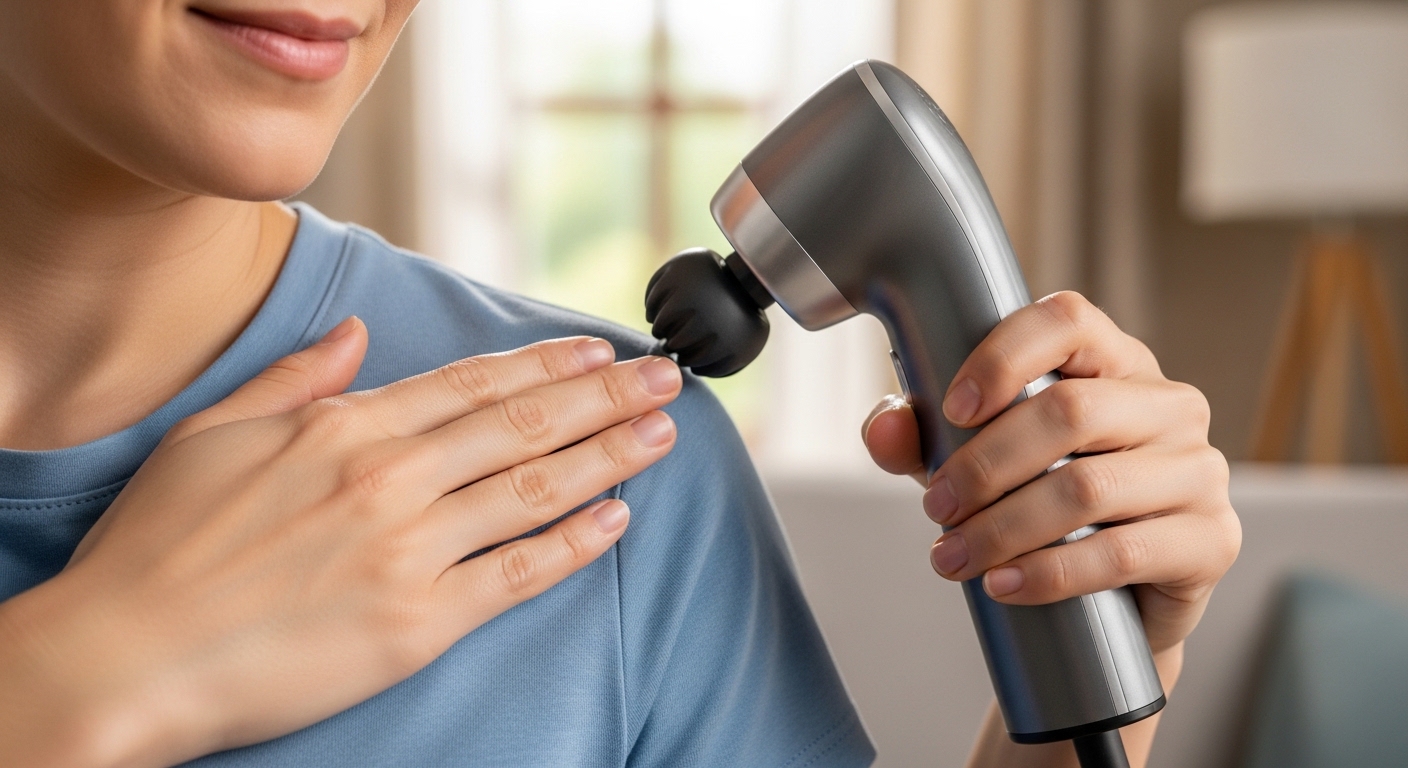
A massage gun should leave you feeling looser and lighter, not bruised, numb, or sore in a bad way. The biggest safety mistakes are simple: too much pressure, too long on one spot, and using it on places it was never meant to touch. This guide is a practical, no-drama routine you can follow every time.
Disclosure: Some links may be affiliate links. As an Amazon Associate I earn from qualifying purchases.
Quick safety rules (remember these)
- Light pressure beats heavy pressure. Let the tool do the work.
- Keep it moving. Don’t “drill” a single point.
- Short sessions win. More time isn’t always better.
- Avoid bones, joints, and the front of the neck.
- Stop immediately if you feel sharp pain, numbness, tingling, or shooting pain.
Who should be extra cautious (or ask a clinician first)
Skip or get medical guidance if you:
- Have a blood clotting disorder, are on blood thinners, or bruise easily
- Have recent surgery, fractures, severe osteoporosis, or acute injury
- Have unexplained swelling, severe pain, numbness, or suspected nerve issues
- Are pregnant (especially avoid low back/abdomen areas)
- Have varicose veins that are painful or inflamed
- Have a known condition like DVT, serious neuropathy, or active infection
Choosing the right pressure (what “safe” feels like)
Use this simple scale:
- 2–3/10 pressure (recommended): comfortable, “good hurt,” you can breathe normally
- 4–5/10 (upper limit): intense but still controlled, no wincing
- 6+/10 (too much): you tense up, hold your breath, or feel sharp pain → back off
The best sign you’re doing it right: you can relax your shoulders and breathe slow while using it.
A good rule of thumb
If your hand is shaking or you’re pressing so hard the device stalls, it’s too much.
Timing: how long per muscle group?
You don’t need long sessions.
For daily tightness (most people)
- 30–60 seconds per muscle group, 1–2 times total
For post-workout soreness
- 60–90 seconds per muscle group, 1–2 passes
Total session time
Aim for 5–10 minutes for a full routine. More than 15 minutes usually adds irritation without extra benefit.
Speed settings (simple guidance)
- Low speed: warm-up, sensitive areas, first-time use
- Medium: most muscle groups, everyday use
- High: only if it still feels comfortable and you’re not pressing hard
If you’re on high speed and high pressure, that’s the combo that causes problems.
Best attachments (and when to use them)
- Ball head: safest all-around (large muscles: glutes, quads, calves)
- Flat head: broad areas (hamstrings, chest muscles, upper back—careful around bones)
- Bullet head: pinpoint spots (use lightly, short time—easy to overdo)
- Fork head: around the spine/neck muscles beside the spine (never on the spine)
If you’re unsure: start with the ball.
Where you SHOULD avoid using a massage gun
These are common “don’t do it” zones:
1) Directly on bones and joints
- Kneecap, elbows, ankles, wrists, collarbone, spine
Why: vibration over bone/joint can irritate tissue and nerves fast.
2) Front and sides of the neck (major safety one)
Avoid the throat area and the sides where major blood vessels run.
Why: sensitive structures; risk isn’t worth it.
3) Spine (the bony center line)
You can use it on muscles next to the spine (erectors), not on the vertebrae.
4) Armpits, groin, and behind the knee
These areas contain major nerves and vessels.
5) Areas with acute injury or inflammation
- Fresh sprains/strains, swollen joints, bruises, open wounds, skin infections
6) Varicose veins (especially painful ones)
Avoid applying percussion directly.
Safe spots (where massage guns work best)
These areas are usually safe if you use light pressure and keep moving:
- Calves (avoid Achilles tendon and shin bone)
- Quads (front thigh)
- Hamstrings (back thigh)
- Glutes/hips (avoid direct hip bone)
- Upper back muscles (traps, lats—avoid spine)
- Forearms (great for desk/phone tension)
- Chest/pecs (lightly, avoid collarbone area)
A safe 6-minute routine (easy to repeat)
Use low-to-medium speed, light pressure.
- Calves — 45 sec each
- Quads — 45 sec each
- Hamstrings — 45 sec each
- Glutes — 60 sec each
- Upper traps — 30 sec each side (stay away from neck front/sides)
Done.
Optional: finish with 30 seconds of gentle stretching for that muscle group.
Technique: how to move the gun (the safe way)
- Keep the head flat against the muscle
- Move slowly: about 1 inch per second
- Do 2 styles:
- Sweep: move across the muscle
- Hover + micro-move: pause 2–3 seconds on a tight area, then move
Avoid “pinning” one spot for 20–30 seconds—that’s how you get bruised.
Signs you’re overdoing it
Stop and reduce pressure/time next session if you notice:
- Bruising or tenderness that lasts more than 24–48 hours
- Increased tightness (your body “guards” the muscle)
- Numbness, tingling, radiating pain
- Headache after neck/upper trap use
- Feeling worse instead of looser
Massage gun vs stretching (when each helps)
- Massage gun: best for short-term relief and helping muscles relax
- Stretching/mobility: best for long-term changes in tightness
The best combo is: massage gun 1–2 minutes → gentle stretch 30 seconds.
Bottom line
To use a massage gun safely:
- Use light pressure (2–4/10)
- Keep it moving, 30–90 seconds per muscle
- Avoid bones, joints, spine, front/sides of neck, armpits/groin/behind knee
- Stop if you feel sharp pain, numbness, tingling, or shooting pain