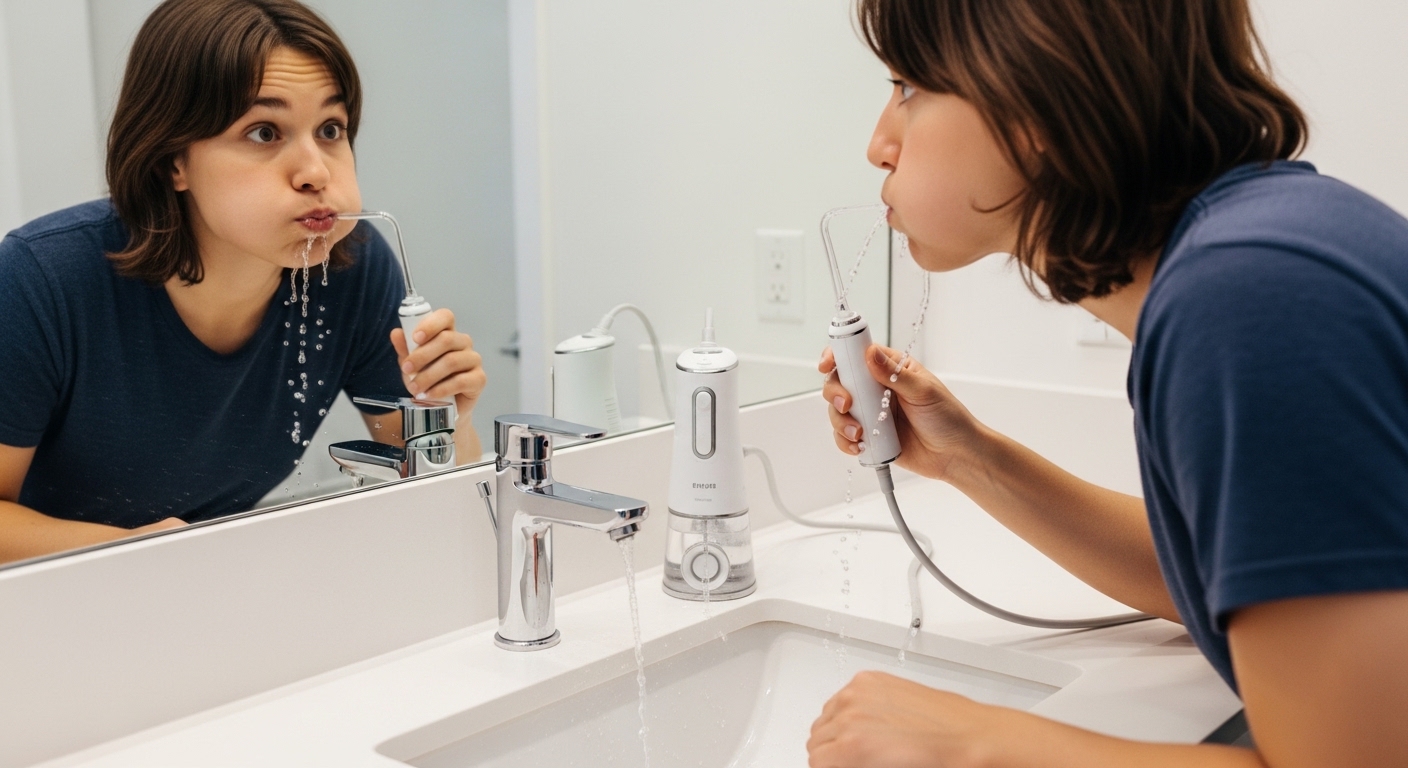
Water flossers work—but the first few tries can feel like you’re pressure-washing your bathroom mirror. The secret isn’t “stronger pressure.” It’s angle, pacing, and a simple routine you’ll actually repeat.
Disclosure: Some links may be affiliate links. As an Amazon Associate I earn from qualifying purchases.
Why water flossers get messy (and how to stop it fast)
Most mess happens for three reasons:
- You turn it on before the tip is in your mouth.
- You open your lips too wide while the water is running.
- Pressure is too high before you’ve learned the angle.
The fix is simple: seal + lean + low pressure for the first week.
The best setup (30 seconds)
1) Fill + check the tip
- Use lukewarm water if your gums are sensitive.
- Make sure the tip is fully clicked in (a loose tip can spray sideways).
2) Stand over the sink the “right” way
- Lean forward so your face is over the bowl, not upright.
- Keep your chin slightly down—think “looking into the sink.”
3) Start with lips closed (not clamped)
- Close your lips around the handle enough to prevent splatter.
- Let the water drip out into the sink from the corners of your mouth.
This alone eliminates 80% of the mess.
Pressure settings that actually make sense
If your gums bleed or feel tender
- Start on low (the lowest 1–2 levels).
- Use it daily for a week before increasing.
If your gums are healthy and you want deeper cleaning
- Move to medium once you can keep it tidy and comfortable.
- High pressure is optional—not required for results.
The “golden rule” for pressure
If you’re getting:
- splatter everywhere → pressure is too high or mouth is too open
- gum sting → pressure is too high or angle is too direct
- no feeling of cleaning → slow down and trace the gumline (don’t instantly crank pressure)
Most people get better results by going slower, not stronger.
The correct angle (this is the whole game)
Aim the stream:
- Along the gumline, not straight into the gums
- At about a 90° angle to the teeth, but slightly tipped toward the gumline
- Think: “Trace the line where tooth meets gum.”
What not to do
- Don’t shoot water directly into the gum pocket like a needle.
- Don’t aim at the center of the tooth and hope it reaches the edges.
- Don’t blast between teeth at high pressure right away.
A 2-minute routine that sticks (simple order, no thinking)
This is the routine I use because it’s repeatable and doesn’t feel like a chore.
Step 1 (20 seconds): Front teeth “quick pass”
- Tip in mouth → turn on
- Trace the gumline across the front top teeth, then bottom
- Don’t chase perfection—this is just to get momentum
Step 2 (60 seconds): Upper arch (left to right)
- Start at the back molars
- Pause 1–2 seconds per gap
- Trace gumline, then lightly sweep between teeth
Step 3 (60 seconds): Lower arch (left to right)
- Same idea: back molars → across → finish front
Step 4 (10 seconds): Final rinse + done
- Turn off before you pull it out of your mouth
- Quick rinse of the tip and tank
Habit tip: Do it right after brushing at night. If you try to “remember later,” it won’t happen.
Timing guide (how long per tooth?)
You don’t need to water floss forever. Use this as a simple guide:
- 1–2 seconds per space for maintenance
- 2–3 seconds on areas that bleed or trap food (temporarily)
If you’re spending 10 seconds on one spot, you’re probably overdoing it.
The “no-mess” checklist (print this in your brain)
- ✅ Tip in mouth before turning on
- ✅ Lean over sink
- ✅ Lips mostly closed; let water drip out
- ✅ Start low pressure
- ✅ Trace gumline slowly
- ✅ Turn off before removing tip
Common mistakes (and quick fixes)
Mistake: “It sprays everywhere”
Fix: Close lips more + lower pressure + lean further over sink.
Mistake: “My gums hurt”
Fix: Lower pressure + angle away from the gum tissue (aim along the gumline, not into it).
Mistake: “It takes too long”
Fix: Follow the 2-minute order (upper arch then lower). Don’t freestyle.
Mistake: “I still get food stuck”
Fix: Slow down at molars and tight areas; pause 2 seconds. Consistency matters more than force.
Does water flossing help bleeding gums?
Often, yes—especially if bleeding is from mild gum inflammation. But bleeding should gradually improve with consistent daily cleaning.
When to get checked:
If bleeding doesn’t improve after ~2 weeks of daily use, or you have swelling, pain, bad taste, or loose teeth.
Extra tips from real use (small things that help a lot)
- Use lukewarm water if cold water makes you sensitive
- If you’re in a rush, do just the back teeth (that’s where most gunk hides)
- Keep it visible on the counter for the first month—out of sight = out of habit
- If you wear braces or have dental work, go slower and trace around hardware
Bottom line
To use a water flosser without making a mess:
- Start low pressure
- Keep your lips mostly closed
- Lean over the sink
- Trace the gumline slowly
- Follow the same 2-minute order every time